

In stock
In stock
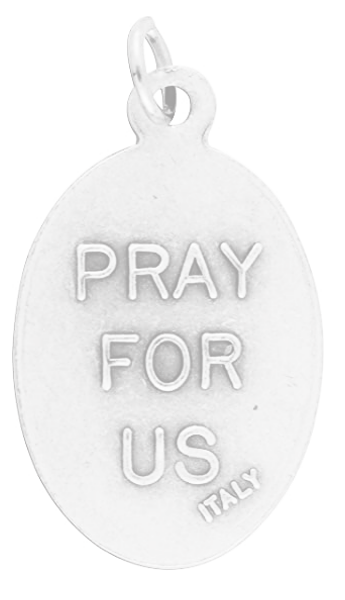
Nickel plated
2.5cm x 1.5cm


According to her apochryphal tradition, she was a resident of Caesarea, Cappadocia, who when she refused to
sacrifice
to the gods during Emperor Diocletian’s
persecution
of the Christians, was tortured by the governor and ordered executed. On the way to the place of execution, she met a young lawyer, Theophilus, who mockingly asked her to send him fruits from “the garden” she had joyously announced she would soon be in. When she knelt for her execution, she prayed, and an
angel
with a basket of three roses and three apples, which she sent to Theophilus, telling him she would meet him in the garden.
Theophilus
was converted to
Christianity
and later was martyred. Her
feast day
is February 6th.
Dorothea and her companion, Theophilus, are mentioned in the Roman Martyrology as martyrs of Caesarea in Cappadocia, with a feast on 6 February.
[3]
She is officially recognized as a virgin martyr. However, since only those feast of saints should be extended to the universal church which commemorate saints who are truly of universal significance,
[4]
her feast is no longer included in the General Roman Calendar, but in some regional calendars.

The earliest record that mentions Dorothea is found in the
Martyrologium Hieronymianum
. This first record contains only three basic facts: the day of martyrdom, the place where it occurred, and her name and that of Theophilus.
[5]
Virgin and martyr, Dorothea of Caesarea was persecuted during the persecution of Diocletian, 6 February, 311, at Caesarea in Cappadocia. She was brought before the prefect Sapricius, tried, tortured, and sentenced to death. On her way to the place of execution the pagan lawyer Theophilus said to her in mockery: “Bride of Christ, send me some fruits from your bridegroom’s garden.” Before she was executed, she sent him, by a six-year-old boy, her headdress which was found to be filled with a heavenly fragrance of roses and fruits. Theophilus at once confessed himself a Christian, was put on the rack, and suffered death. This is the oldest version of the legend, which was later variously enlarged
[6]
(The boy with the basket can be seen in the depictions by Josse van der Baren and Hans Baldung Grien in the gallery below).
The oldest known version of the legend is Aldhelm’s
De laudibus virginitatis
, addressed to Abbess Hildelitha of Barking Abbey, Essex. Kirsten Wolf characterizes it as one of several legends invented in the fourth and fifth centuries to provide a story to go with a name on one of the various liturgical calendars.
[7]
In the Western church Dorothy of Caesarea has been venerated since the seventh century. Since the fourteenth century many artists created paintings and sculptures, which are to be found throughout Europe.
[8]
In late medieval Sweden Saint Dorothy was considered to be the 15th of the Holy Helpers,
[8]
and in arts she occurred with Saints Barbara, Catherine and Margaret, forming with them a quartet of female virgin martyrs called
Quattuor Virgines Capitales
, meaning “The four Capital Virgins”.
Dorothy of Caesarea is regarded as the patroness of gardeners, due to her virginal attribute of a wreath of roses.
[6]
On her feast on 6 February trees are blessed.
[6]
Saint Dorothy is also patroness of brewers, brides, florists, midwives, newlyweds and of the village of Pescia in Italy.
The Sisters of St. Dorothy is a congregation of sisters, occupied primarily with teaching.
[9]
Dorothy of Caesarea’s life and martyrdom was the basis of Philip Massinger and Thomas Dekker’s
The Virgin Martyr
(printed 1622).
| Weight | 0,10000000 kg |
|---|---|
| Dimensions | 3,0 × 2,0 × 1,0 cm |
You must be logged in to post a review.


Reviews
There are no reviews yet.