Description
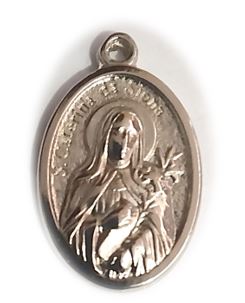
Catherine of Siena Medal
2.5cm x 1.5cm wide
Facts Feastday:
April 29
Patron:
Fire prevention
Birth: 1347
Death: 1380
St. Catherine of Siena was born during the outbreak of the plague in
Siena, Italy on March 25, 1347. She was the 25th child born to her
mother, although half of her brothers and sisters did not survive
childhood. Catherine herself was a twin, but her sister did not survive
infancy. Her mother was 40 when she was born. Her father was a cloth
dyer.
At the age of 16, Catherine’s sister, Bonaventura, died, leaving her
husband as a widower. Catherine’s parents proposed that he marry
Catherine as a replacement, but Catherine opposed this. She began
fasting and cut her hair short to mar her appearance.
Her parents attempted to resist this move, to avoid marriage, but
they were unsuccessful. Her fasting and her devotion to her family,
convinced them to relent and allow her to live as she pleased. Catherine
once explained that she regarded her father as a representation of
Jesus and her mother as Our Lady, and her brothers as the apostles,
which helped her to serve them with humility.
Despite Catherine’s religious nature, she did not choose to enter a
convent and instead she joined the Third Order of St. Dominic, which
allowed her to associate with a religious society while living at home.
Fellow Dominican sisters taught St. Catherine how to read. Meanwhile, she lived quietly, isolated within her family home.
St. Catherine developed a habit of giving things away and she
continually gave away her family’s food and clothing to people in need.
She never asked permission to give these things away, and she quietly
put up with their criticisms.
Something changed her when she was 21. She described an experience
she referred to as her “mystical marriage to Christ.” There are debates
over whether or not St. Catherine was given a ring with some claiming
she was given a bejeweled ring, and other claiming the ring was made of
Jesus’s skin. St. Catherine herself started the rumor of the latter in
her writings, but she was known to often claim the ring itself was
invisible.
Such mystical experiences change people, and St. Catherine was no
exception. In her vision, she was told to reenter public life and to
help the poor and sick. She immediately rejoined her family and went
into public to help people in need.
St. Catherine was drawn further into the world as she worked, and
eventually she began to travel, calling for reform of the Church and for
people to confess and to love God totally. She became involved in
politics, and was key in working to keep city states loyal to the Pope.
She was also credited with helping to start a crusade to the Holy Land.
On one occasion, she visited a condemned political prisoner and was
credited with saving his soul, which she saw being taken up to heaven at
the moment of his death.
St. Catherine allegedly was given the stigmata, but like her ring, it
was visible only to herself. She took Bl. Raymond of Capua has her
confessor and spiritual director.
From 1375 onwards, St. Catherine began dictating letters to scribes.
She petitioned for peace and was instrumental in persuading the Pope in
Avignon to return to Rome.
She became involved in the fractured politics of her time, but was
instrumental in restoring the Papacy to Rome and in brokering peace
deals during a time of factional conflict and war between the Italian
city states.
She also established a monastery for women in 1377 outside of Siena.
She is credited with composing over 400 letters, her Dialogue, which is
her definitive work, and her prayers. These works are so influential
that St. Catherine would later be declared a Doctor of the Church. She
is one of the most influential and popular saints in the Church.
By 1380, the 33-year-old mystic had become ill, possibly because of
her habit of extreme fasting. Her confessor, Raymond, ordered her to
eat, but she replied that she found it difficult to do so, and that
possibly she was ill.
In January of 1380, her illness accelerated her inability to eat and
drink. Within weeks, she was unable to use her legs. She died on April
29, following a stroke just a week prior.
St. Catherine’s feast day is April 29, she is the patroness against
fire, illness, the United States, Italy, miscarriages, people ridiculed
for their faith, sexual temptation, and nurses.
She often visited hospitals and homes where the poor and sick were
found. Her activities quickly attracted followers who helped her in her
mission to serve the poor and sick.
St. Catherine was drawn further into the world as she worked, and
eventually she began to travel, calling for reform of the Church and for
people to confess and to love God totally. She became involved in
politics, and was key in working to keep city states loyal to the Pope.
She was also credited with helping to start a crusade to the Holy Land.
On one occasion, she visited a condemned political prisoner and was
credited with saving his soul, which she saw being taken up to heaven at
the moment of his death.
St. Catherine allegedly was given the stigmata, but like her ring, it
was visible only to herself. She took Bl. Raymond of Capua has her
confessor and spiritual director.
From 1375 onwards, St. Catherine began dictating letters to scribes.
She petitioned for peace and was instrumental in persuading the Pope in
Avignon to return to Rome.
She became involved in the fractured politics of her time, but was
instrumental in restoring the Papacy to Rome and in brokering peace
deals during a time of factional conflict and war between the Italian
city states.
She also established a monastery for women in 1377 outside of Siena.
She is credited with composing over 400 letters, her Dialogue, which is
her definitive work, and her prayers. These works are so influential
that St. Catherine would later be declared a Doctor of the Church. She
is one of the most influential and popular saints in the Church.
By 1380, the 33-year-old mystic had become ill, possibly because of
her habit of extreme fasting. Her confessor, Raymond, ordered her to
eat, but she replied that she found it difficult to do so, and that
possibly she was ill.
In January of 1380, her illness accelerated her inability to eat and
drink. Within weeks, she was unable to use her legs. She died on April
29, following a stroke just a week prior.
St. Catherine’s feast day is April 29, she is the patroness against
fire, illness, the United States, Italy, miscarriages, people ridiculed
for their faith, sexual temptation, and nurses.



Reviews
There are no reviews yet.