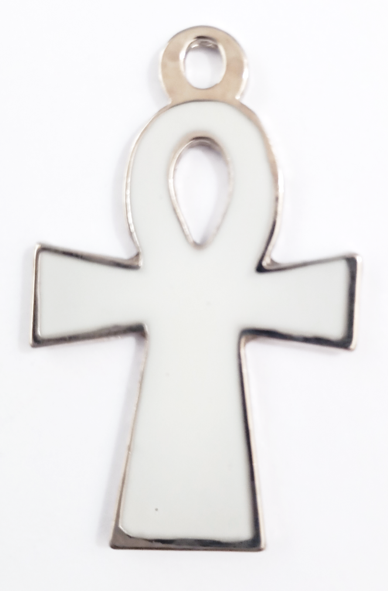
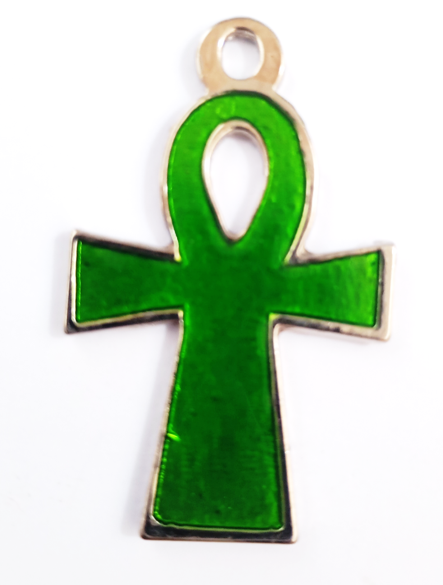
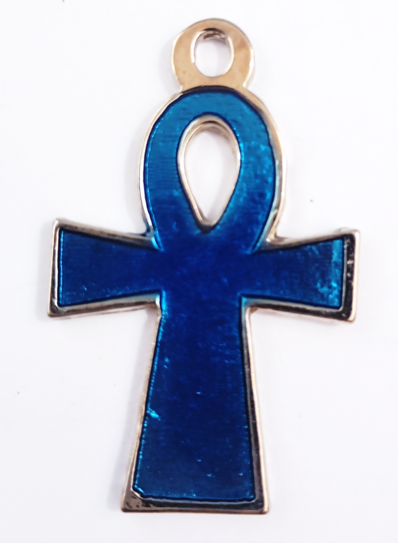
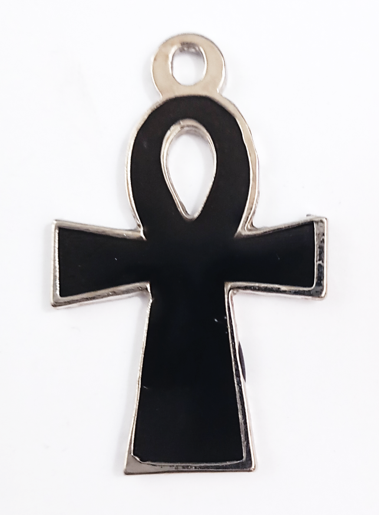
Beautiful Ankh – Christian name is the “Crux Ansata Cross”
metal with various colour enamel inlay
4cm – nickel plated
Throughout human history, symbols have played a crucial role in communication, often representing complex ideas and beliefs succinctly. Two of the most enduring and significant symbols are the Egyptian Ankh and the Christian Cross. Despite their origins in vastly different cultures and time periods, both symbols share intriguing similarities and stark contrasts. This article delves into the history, meanings, and cultural significance of the Ankh and the Cross, exploring how they have influenced and been interpreted by their respective societies.
The Egyptian Ankh: Symbol of Life
Historical Context
The Ankh, also known as the “key of life” or “crux ansata” (Latin for “cross with a handle”), is one of the most recognizable symbols from ancient Egypt. It dates back to the Early Dynastic Period (c. 3150–2613 BCE) and became prevalent throughout the Old, Middle, and New Kingdoms.
Symbolism and Meaning
The Ankh is traditionally depicted as a cross with a loop at the top. It represents life and immortality, making it a potent symbol of existence, both earthly and eternal. The loop symbolizes the sun rising on the horizon, signifying eternal life, while the crossbar and the vertical line represent the physical and spiritual planes.
Use in Ancient Egypt
In Egyptian art, the Ankh is frequently seen in the hands of gods, pharaohs, and other figures of importance, symbolizing their life-giving power and divine protection. It is often shown being bestowed upon the lips of the deceased, granting them the breath of life necessary for the afterlife.
The Christian Cross: Symbol of Faith
Historical Context
The Christian Cross, particularly the Latin Cross, is the principal symbol of Christianity, representing the crucifixion of Jesus Christ and the redemption it brought to humanity. While the cross was used as a method of execution in the Roman Empire, it gained religious significance following the crucifixion of Jesus in the 1st century CE.
Symbolism and Meaning
The Cross is a potent emblem of sacrifice, salvation, and faith. Its vertical and horizontal bars symbolize the intersection of the divine and human realms. For Christians, it serves as a reminder of Jesus’ suffering and the hope of resurrection and eternal life.
Use in Christianity
The Cross is ubiquitous in Christian worship and iconography. It appears on churches, altars, and personal jewelry. During religious ceremonies, it is often used in rituals such as the Eucharist and baptism, symbolizing the faith and devotion of the believers.
Comparing the Ankh and the Cross
Similarities
Symbol of Life and Eternality: Both the Ankh and the Cross symbolize life. The Ankh represents physical and eternal life, while the Cross signifies spiritual salvation and eternal life through Christ.
Cultural Importance: Each symbol holds a central place in its respective culture. The Ankh was a ubiquitous symbol in ancient Egyptian society, much like the Cross is in Christian culture today.
Spiritual Connection: Both symbols represent a connection between the earthly and the divine. The Ankh connects the physical world with the eternal, while the Cross signifies the union of humanity with God through Jesus.
Differences
Origin and Evolution: The Ankh originates from ancient Egypt, while the Cross is rooted in Roman execution methods and later adopted by Christians. Their historical contexts and paths to prominence are vastly different.
Symbolic Emphasis: The Ankh emphasizes life and vitality in both the physical and afterlife realms. The Cross, however, focuses on sacrifice, redemption, and the promise of spiritual eternal life.
Design and Iconography: Visually, the Ankh is distinct with its looped top, while the Cross is straightforward with its intersecting bars. Their designs reflect their unique cultural and religious meanings.
The Ankh’s Influence on Modern Culture
Contemporary Interpretations
In modern times, the Ankh has transcended its ancient origins to become a symbol in various cultural and spiritual contexts. It is often associated with African heritage and identity, symbolizing a connection to ancient wisdom and life-giving energy.
Popular Culture
The Ankh has found its way into popular culture, appearing in fashion, jewelry, and tattoos. It is also featured in movies, literature, and art, often as a mystical or esoteric symbol.
The Cross in Modern Christianity
Contemporary Significance
The Cross remains a powerful symbol of faith for Christians worldwide. It is a reminder of the teachings of Jesus and the hope of salvation. In contemporary Christianity, the Cross is also a symbol of unity, bringing together believers from diverse backgrounds.
Cross in Popular Culture
Like the Ankh, the Cross has permeated popular culture. It appears in fashion, art, and media, often as a symbol of faith, rebellion, or even fashion statement. Its presence in secular contexts sometimes sparks debate about the appropriation and commercialization of religious symbols.
Conclusion: A Journey Through Symbols
The Ankh and the Cross, though originating from distinct cultures and eras, share a common thread as symbols of profound spiritual significance. They represent humanity’s quest for understanding life, death, and the divine. Through their rich histories and enduring presence, they continue to inspire and evoke deep reflection on the mysteries of existence and faith.
As we examine these symbols, we gain insight into the civilizations that created them and the timeless human themes they represent. Whether one views the Ankh as a relic of ancient Egypt or the Cross as the cornerstone of Christian faith, both symbols offer a window into the profound spiritual aspirations that have shaped human history.




Reviews
There are no reviews yet.